

AZ-120 exam questions for practice in 2026 Updated 326 Questions
Updated Aug-2026 Premium AZ-120 Exam Engine pdf - Download Free Updated 326 Questions
Prerequisites
The candidates for this certification exam are expected to possess extensive knowledge and experience with the SAP applications. These include SAP NetWeaver, SAP HANA, SAP BW/4HANA, S/4HANA, operating systems, OS servers for databases and SAP applications, ARM templates, and Azure portals. The SAP applications also include storage structures, virtualization, high availability design, data protection concepts, Cloud infrastructure, networking, and disaster recovery design.
It is also recommended that the students have the Microsoft Certified: Azure Solutions Architect Expert or at least Microsoft Certified: Azure Administrator Associate certificate before taking the Microsoft AZ-120 exam. They may also earn the Linux and SAP HANA certifications to improve their success in pursuing Microsoft Certified: Azure for SAP Workloads Specialty.
The AZ-120 certification exam covers a wide range of topics, including Azure infrastructure, SAP HANA and SAP NetWeaver, security and compliance, networking, and storage. Candidates who pass the exam will have a deep understanding of how to deploy, configure, monitor, and troubleshoot SAP solutions on Microsoft Azure.
Step 4: Joining a Community
The candidates can also become a part of community of the co-learners as this can help them pace the preparation process. Joining online forums or study groups gives you an opportunity to share your issues with other people who are on the same journey with you.
NEW QUESTION # 105
Note: This section contains one or more sets of questions with the same scenario and problem. Each question presents a unique solution to the problem. You must determine whether the solution meets the stated goals.
More than one solution in the set might solve the problem. It is also possible that none of the solutions in the set solve the problem.
After you answer a question in this section, you will NOT be able to return. As a result, these questions do not appear on the Review Screen.
You have an on-premises datacenter.
You have an Azure subscription that contains a virtual network named VNet1.
You have an SAP RISE managed workload.
You need to ensure transitive connectivity between the datacenter. VNet1, and the managed workload.
Solution: You configure a Site-to-Site (S2S) VPN connection between the datacenter and the managed workload and virtual network peering between VNet1 and the managed workload.
Does this meet the goal?
- A. Yes
- B. No
Answer: B
NEW QUESTION # 106
Your on-premises network contains an Active Directory domain.
You have an SAP environment on Azure that runs on SUSE Linux Enterprise Server (SLES) servers.
You configure the SLES servers to use domain controllers as their NTP servers and their DNS servers.
You need to join the SLES servers to the Active Directory domain.
Which three actions should you perform in sequence? To answer, move the appropriate actions from the list of actions to the answer area and arrange them in the correct order.
Answer:
Explanation:
Explanation:
Step 1: Install the samba-winbind package
Install samba-winbind
Step 2: Add realm details to /etc/krb5.conf and /etc/samba/smb.conf
Edit files - best way to do this is to use yast on test machine and copy files from it In following examples you need to replace EXAMPLE/EXAMPLE.COM/.example.com with your values
/settings
/etc/samba/smb.conf
[global]
workgroup = EXAMPLE
usershare allow guests = NO #disallow guests from sharing
idmap gid = 10000-20000
idmap uid = 10000-20000
kerberos method = secrets and keytab
realm = EXAMPLE.COM
security = ADS
template homedir = /home/%D/%U
template shell = /bin/bash
winbind offline logon = yes
winbind refresh tickets = yes
/etc/krb5.conf
[libdefaults]
default_realm = EXAMPLE.COM
clockskew = 300
[realms]
EXAMPLE.COM = {
kdc = PDC.EXAMPLE.COM
default_domain = EXAMPLE.COM
admin_server = PDC.EXAMPLE.COM
}
Step 3: Run net ads join -U administrator
Join the SLES 12 Server to the AD domain
References:
https://www.suse.com/support/kb/doc/?id=7018461
NEW QUESTION # 107
For each of the following statements, select Yes if the statement is true. Otherwise, select No. NOTE: Each correct selection is worth one point.
Answer:
Explanation:
NEW QUESTION # 108
You have an SAP on Azure landscape. You need to gather the following metrics:
* The network latency between an SAP NetWeaver server and an SAP HANA server.
* The throughput and latency of the storage subsystem on Windows Server and Linux platforms What should you use for each metric? To answer, select the appropriate options in the answer area. NOTE:
Each correct selection is worth one point.
Answer:
Explanation:
Explanation
NEW QUESTION # 109
For each of the following statements, select Yes if the statement is true. Otherwise, select No. NOTE: Each correct selection is worth one point.
Answer:
Explanation:
Explanation:
NEW QUESTION # 110
You have an SAP production landscape that uses SAP HANA databases.
You configure a metric alert for the primary HANA server as shown in the following exhibit.

Answer:
Explanation:
Explanation:
Box 1: No
The period is 15 minutes. Only alerts or emails will be sent.
Box 2: Yes
Box 3: Yes
NEW QUESTION # 111
For each of the following statements, select Yes if the statement is true. Otherwise, select No.
NOTE: Each correct selection is worth one point.
Answer:
Explanation:
Explanation:
Box 1: No
Box 2: Yes
The minimum SAP HANA certified conditions for the different storage types are:
Azure Premium SSD - /hana/log is required to be cached with Azure Write Accelerator. The /hana/data volume could be placed on Premium SSD without Azure Write Accelerator or on Ultra disk Box 3: Yes References:
https://docs.microsoft.com/en-us/azure/virtual-machines/workloads/sap/hana-vm-operations-storage
NEW QUESTION # 112
You have an SAP environment on Azure.
You use Azure Recovery Services to back up an SAP application server.
You need to test the restoration process of a file on the server.
Which three actions should you perform in sequence? To answer, move the appropriate actions from the list of actions to the answer area and arrange them in the correct order.
Answer:
Explanation:
Explanation
Step 1: From Azure Recover Vault, select File Recovery
To restore files or folders from the recovery point, go to the virtual machine and choose the desired recovery point.
Step 2: Download and run the mount disk executable
Step 3: recover the file and unmount the disk
NEW QUESTION # 113
For each of the following statements, select Yes if the statement is true. Otherwise, select No.
NOTE: Each correct selection is worth one point.
Answer:
Explanation:
Explanation:
Box 1: Yes
The SAP Azure Enhanced Monitoring Extension builds on top of the Azure Diagnostic extension, which stores its data in an Azure Storage account that you specify.
Box 2: Yes
The Set-AzVMAEMExtension cmdlet updates the configuration of a virtual machine to enable or update the support for monitoring for SAP systems that are installed on the virtual machine. The cmdlet installs the Azure Enhanced Monitoring (AEM) extension that collects the performance data and makes it discoverable for the SAP system.
The -OSType specifies the OS. Either Windows or Linux.
Box 3: Yes
References:
https://docs.microsoft.com/en-us/azure/azure-monitor/platform/diagnostics-extension-overview
https://docs.microsoft.com/en-us/powershell/module/az.compute/set-azvmaemextension
NEW QUESTION # 114
You have an Azure subscription that contains a Recovery Services vault named RSV1 and a virtual machine named VM1. VM1 runs SUSE Enterprise Linux (SLES) and hosts an SAP HANA instance.
You need to configure a HANA 8ackint-based backup of the HANA databases.
You register VM1 with RSV1.
What should you do next?
- A. On VM1, stop the HANA instance.
- B. From RSV1, select the items to back up.
- C. On VM1, run the preregistration script.
- D. On VM1, install the Azure Backup Plugin for HANA.
Answer: C
NEW QUESTION # 115
You have an SAP NetWeaver deployment hosted on Azure virtual machines that run SUSE Linux Enterprise Server (SLES) and are configured as a Pacemaker cluster.
You need to monitor the deployment by using Azure Monitor for SAP Solutions.
What should you install first on the cluster nodes?
- A. pcp-pmda-hacluster
- B. ha_duster_provider
- C. Performance Co-Pilot
- D. PMProxy
Answer: D
NEW QUESTION # 116
For each of the following statements, select Yes if the statement is true. Otherwise, select No.
NOTE: Each correct selection is worth one point.
Answer:
Explanation:
Reference:
https://azure.microsoft.com/en-us/blog/maximize-your-vm-s-performance-with-accelerated-networking-now-generally-available-for-both-windows-and-linux/
https://azure.microsoft.com/en-gb/blog/maximize-your-vm-s-performance-with-accelerated-networking-now-generally-available-for-both-windows-and-linux/
NEW QUESTION # 117
You have an SAP on Azure deployment that contains a production landscape, a development landscape, and a quality assurance landscape. All the landscapes are hosted on Azure virtual machines.
You need to create a monthly report that identifies opportunities for performance and security optimization.
The solution must minimize administrative effort
What should you use?
- A. Azure Advisor
- B. SAP HANA hardware and cloud measurement tools
- C. SAP GUI
- D. Azure Monitor
Answer: A
NEW QUESTION # 118
You are deploying an SAP production landscape in Azure.
You need to create an Azure policy that meets the following requirements:
* Limits which applications can be installed on virtual machines
* Ensures that when a virtual machine is deployed, the virtual machine has the latest version of the extension to be installed How should you complete the policy? To answer, select the appropriate options in the answer area.
NOTE: Each correct selection is worth one point.
Answer:
Explanation:
Explanation
NEW QUESTION # 119
Note: This question is part of a series of questions that present the same scenario. Each question in the series contains a unique solution that might meet the stated goals. Some question sets might have more than one correct solution, while others might not have a correct solution.
After you answer a question in this section, you will NOT be able to return to it. As a result, these questions will not appear in the review screen.
You have a complex SAP environment that has both ABAP- and Java-based systems. The current on-premises landscapes are based on SAP NetWeaver 7.0 (Unicode and Non-Unicode) running on Windows Server and Microsoft SQL Server.
You need to migrate the SAP environment to an Azure environment.
Solution: You migrate the SAP environment as is to Azure by using Azure Site Recovery.
Does this meet the goal?
- A. Yes
- B. No
Answer: B
Explanation:
Explanation
We need upgrade to SAP NetWeaver 7.4 before the migration.
Reference:
https://docs.microsoft.com/en-us/azure/site-recovery/vmware-azure-architecture
NEW QUESTION # 120
You are evaluating the proposed backup policy.
For each of the following statements, select Yes if the statement is true. otherwise, select No.
NOTE: Each correct selection is worth one point.
Answer:
Explanation:
Reference:
https://docs.microsoft.com/en-us/azure/backup/backup-instant-restore-capability
Topic 1, Contoso Ltd Case Study
Overview
This is a case study. Case studies are not timed separately. You can use as much exam time as you would like to complete each case. However, there may be additional case studies and sections on this exam. You must manage your time to ensure that you are able to complete all questions included on this exam in the time provided.
To answer the questions included in a case study, you will need to reference information that is provided in the case study. Case studies might contain exhibits and other resources that provide more information about the scenario that is described in the case study. Each question is independent of the other questions in this case study.
At the end of this case study, a review screen will appear. This screen allows you to review your answers and to make changes before you move to the next section of the exam. After you begin a new section, you cannot return to this section.
To start the case study
To display the first question in this case study, click the Next button. Use the buttons in the left pane to explore the content of the case study before you answer the questions. Clicking these buttons displays information such as business requirements, existing environment, and problem statements. If the case study has an All Information tab, note that the information displayed is identical to the information displayed on the subsequent tabs. When you are ready to answer a question, click the Question button to return to the question.
Overview
Contoso, Ltd. is a manufacturing company that has 15,000 employees.
The company uses SAP for sales and manufacturing.
Contoso has sales offices in New York and London and manufacturing facilities in Boston and Seattle.
Existing Environment
Active Directory
The network contains an on-premises Active Directory domain named ad.contoso.com. User email addresses use a domain name of contoso.com.
SAP Environment
The current SAP environment contains the following components:
SAP Solution Manager
SAP ERP Central Component (SAP ECC)
SAP Supply Chain Management (SAP SCM)
SAP application servers that run Windows Server 2008 R2
SAP HANA database servers that run SUSE Linux Enterprise Server 12 (SLES 12) Problem Statements Contoso identifies the following issues in its current environment:
The SAP HANA environment lacks adequate resources.
The Windows servers are nearing the end of support.
The datacenters are at maximum capacity.
Requirements
Planned Changes
Contoso identifies the following planned changes:
Deploy Azure Virtual WAN.
Migrate the application servers to Windows Server 2016.
Deploy ExpressRoute connections to all of the offices and manufacturing facilities.
Deploy SAP landscapes to Azure for development, quality assurance, and production.
All resources for the production landscape will be in a resource group named SAPProduction.
Business goals
Contoso identifies the following business goals:
Minimize costs whenever possible.
Migrate SAP to Azure without causing downtime.
Ensure that all SAP deployments to Azure are supported by SAP.
Ensure that all the production databases can withstand the failure of an Azure region.
Ensure that all the production application servers can restore daily backups from the last 21 days.
Technical Requirements
Contoso identifies the following technical requirements:
Inspect all web queries.
Deploy an SAP HANA cluster to two datacenters.
Minimize the bandwidth used for database synchronization.
Use Active Directory accounts to administer Azure resources.
Ensure that each production application server has four 1-TB data disks.
Ensure that an application server can be restored from a backup created during the last five days within 15 minutes.
Implement an approval process to ensure that an SAP administrator is notified before another administrator attempts to make changes to the Azure virtual machines that host SAP.
It is estimated that during the migration, the bandwidth required between Azure and the New York office will be 1 Gbps. After the migration, a traffic burst of up to 3 Gbps will occur.
Proposed Backup Policy
An Azure administrator proposes the backup policy shown in the following exhibit.
Azure Resource Manager Template
An Azure administrator provides you with the Azure Resource Manager template that will be used to provision the production application servers.

NEW QUESTION # 121
You have a n SAP environment on Azure.
Your on-premises network uses a 1-Gbps ExpresRoute circuit to connect to Azure Private peering is enabled on the circuit. The default route (0.0.0.0/0) from the on-premises network is advertised You need to resolve the issue without modifying the ExpresRoute circuit. The solution must minimize administrative effort. What should you do?
- A. Change the backup solution to use a third-party software that can write to the Blob storage.
- B. Create an application security group.
- C. Create a user-defined route tint redirects traffic to the Blob storage.
- D. Enable virtual network service endpoints.
Answer: C
NEW QUESTION # 122
You have an on-premises deployment of SAP Business Suite on HANA that includes a CPU-intensive application tier and a 20-TB database tier.
You plan to migrate to SAP HANA on Azure.
You need to recommend a compute option to host the application and database tiers. The solution must minimize cost.
What should you recommend for each tier? To answer, select the appropriate options in the answer area.
NOTE: Each correct selection is worth one point.
Answer:
Explanation:
Explanation
Text Description automatically generated
Box 1: Ev3 series M Azure virtual machines
The Ev3 series pricing is starting from $58.40 /per month.
The E-series Azure VMs are optimized for heavy in-memory applications such as SAP HANA. These VMs are configured with high memory-to-core ratios, which makes them well-suited for memory-intensive enterprise applications, large relational database servers, in-memory analytics workloads etc.
The Ev3-series VMs range from 2 to 64 vCPUs and 16-432 GiB of RAM, respectively.
Example workloads include SAP HANA (e.g., E64s v3, E20ds v4, E32ds v4, E48ds v4, E64ds v4), SAP S/4 HANA application layer, SAP NetWeaver application layer, and more broadly memory-intensive enterprise applications, large relational database servers, data warehousing workloads, business intelligence applications, in-memory analytics workloads, and additional business-critical applications, including systems that process financial transactions of various nature...
Note: The M-series family of Azure virtual machines are memory optimized and are ideal for heavy in-memory workloads such as SAP HANA. The M-Series offer up to 4 TB of RAM on a single VM. In addition, these VMs offer a virtual CPU count of up to 128 vCPUs on a single VM to enable high performance parallel processing.
Example workloads include SAP HANA, SAP S/4 HANA, SQL Hekaton and other large in-memory business critical workloads requiring massive parallel compute power.
Box 2: Hana on Azure (Large Instances)
The storage used in HANA Large Instances has a file size limitation. The size limitation is 16 TB per file.
Reference:
https://docs.microsoft.com/en-us/azure/virtual-machines/workloads/sap/hana-storage-architecture
https://azure.microsoft.com/en-us/pricing/details/virtual-machines/series/
NEW QUESTION # 123
You deploy an SAP production landscape on Azure virtual machines that run SUSE Linux Enterprise Server (SLES).
You need to generate a report that details performance differences between instances of an SAP AS ABAP system.
What should you use?
- A. Micro Focus LoadRunner
- B. JMeter
- C. ABAPmeter
- D. SAP UI5 SpeedtestTool
Answer: C
Explanation:
Explanation
Use ABAPMETER in NetWeaver AS ABAP when you want to test the general performance/health of each instance in a NetWeaver AS ABAP system.
Reference:
https://userapps.support.sap.com/sap/support/knowledge/en/2879613
NEW QUESTION # 124
You are implementing a highly available deployment of SAP HANA on Azure virtual machines. You need to ensure that the deployment meets the following requirements:
* Supports host auto-failover
* Minimizes cost
How should you configure the highly available components of the deployment? To answer, select the appropriate options in the answer area. NOTE: Each correct selection is worth one point.
Answer:
Explanation:
see the explanation for below image
Explanation
Answer selected as in image below.
NEW QUESTION # 125
You plan to deploy SAP on Azure.
The deployment must meet the following requirements:
* Support failover to another Azure region in the event of a regional outage.
* Minimize data loss during a failover.
* Minimize costs.
Which fault tolerance technology should you choose for the SAP Web Dispatcher and the Microsoft SQL Server 2017 servers to meet the requirements? To answer, drag the appropriate technologies to The correct targets. Each technology may be used once, more than once, or not at all. You may need to drag the split bar between panes or scroll to view content.
NOTE: Each correct selection is worth one point.
Answer:
Explanation:
Explanation: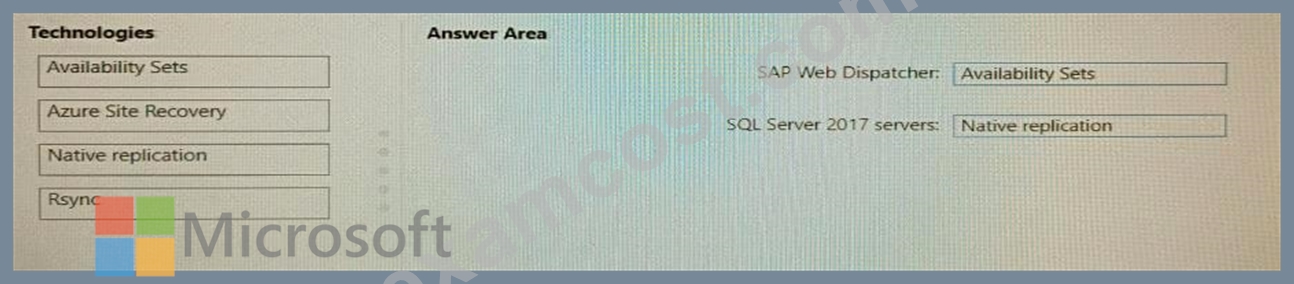
NEW QUESTION # 126
You have an SAP on Azure deployment that contains a production landscape and a non-production landscape.
You have the virtual machines shown in the following table.
You need to minimize the costs of the deployment for the next 12 months. The solution must meet the following requirements:
* Maintain SAP support
* Minimize application impact.
What should you do on each virtual machine? To answer, select the appropriate options in the answer area.
NOTE: Each correct selection is worth one point.
Answer:
Explanation:
Explanation
Topic 1, Litware, inc Case Study
This is a case study. Case studies are not timed separately. You can use as much exam time as you would like to complete each case. However, there may be additional case studies and sections on this exam. You must manage your time to ensure that you are able to complete all question include on this exam in the time provided.
To answer the question included in a case study, you will need to reference information that is provided in the case study. Case studies might contain and other resources that provide information about the scenario that is describe in the case study. Each question is independent of the other question in this case study.
At the end of this case study, a review screen will appear. This screen allows you to review your answer and to make changes before you move to the next section of the exam. After you begin a new section, you cannot return to this section.
To Start the case study
To display the first question in this case study, click the Next button. Use the buttons in the left pane to explore the content of the case study before you answer the questions. Clicking these buttons displays information such the content requirements, existing environment, and problem statements, if the case study has an All Information tab, note that the information displayed its identical to the information displayed on the subsequence tabs. When you are ready to answer a question click the Question button to return to the question.
Overview
Litware, inc. is an international manufacturing company that has 3,000 employees.
Litware has two main offices. The offices are located in Miami, FL, and Madrid Spain.
Existing Environment
Infrastructure
Litware currently uses a third-party provider to host a datacenter in Miami and a disaster recovery datacenter in Chicago, it.
The network contains an Active Directory domain named litware.com.Litware has two third-party applications hosted in Azure.
Litware already implemented a site-to-site VPN connection between the on-premises network and Azure.
SAP Environment
Litware currently runs the following SAP products:
* Enhancement Pack 6 for SAP ERP Central Component 6.0 (SAP ECC 6.0)
* SAP Extended Warehouse Management (SAP EWM)
* SAP Business Warehouse (SAP BW)
* SAP NetWeaver Process Integration (PI)
* SAP Solution Manager
All users run on the Windows Server platform. All databases use Microsoft SQL Server. Currently, you have
20 production servers.
You have 30 non-production servers including five testing severs, five development servers, five quality assurance (QA) servers, and 15 pre=production servers.
Currently, all SAP applications are in the litware.com domain.
Problem Statements
The current version of SAP ECC has a transaction that, when run in batches overnight, tables eight hours to complete. You confirm that upgrading to SAP Business Suite on HANA will improve performance because of code changes and the SAP HANA database platform.
Litware is dissatisfied with the performance of its current hosted infrastructure vendor. Litware experienced several hardware failures and the vendor struggled to adequately its 24/7 business operation.
Business Goals
Litware identifies the following business goals:
* Increase the performance of SAP ECC application by moving to SAP HANA. All other database will remain on SQL Server.
* Move away from the current infrastructure vendor to increase the stability and availability of the SAP services.
* Use the new Environment, Health and Safety (EH&S) in Recipe Management function.
* Ensure that any migration activities can be completed within a 48-hour period during a weekend.
Planned Changes
Litware identifies the following planned changes:
* Migrate SAP to Azure.
* Upgrade and migrate SAP ECC to SAP business Suite on HANA Enhancement Pack 8.
Technical requirements
Litware identifies the following technical requirements:
* Implement automated backups.
* Support load testing during the migrate.
* Identify opportunities to reduces costs during the migration.
* Continue to use the Litware.com domain for all SAP landscapes.
* Ensure that all SAP applications and databases are highly available.
* Remove all SAP components from the on-premises network once the migrate is complete.
* Minimize the purchase of additional SAP licenses. SAP HANA license were already purchased.
* Ensure that SAP can provide technical support for all the SAP landscapes deployed to Azure.
NEW QUESTION # 127
You plan to deploy a highly available ASCS instance to SUSE Linux Enterprise Server (SLES) virtual machines in Azure.
You are configuring an internal Azure Standard Load Balancer for the ASCS instance.
How should you configure the internal Standard Load Balancer? To answer, select the appropriate options in the answer area.
NOTE: Each correct selection is worth one point.
Answer:
Explanation:
Reference:
https://docs.microsoft.com/en-us/azure/virtual-machines/workloads/sap/high-availability-guide-suse
NEW QUESTION # 128
......
Authentic AZ-120 Dumps With 100% Passing Rate Practice Tests Dumps: https://www.examcost.com/AZ-120-practice-exam.html
Microsoft AZ-120 Real Exam Questions Guaranteed Updated Dump from ExamCost: https://drive.google.com/open?id=1rLvntOxduChLAwnoBcAseYg7AF3NNyEz
