

Released HP HPE6-A78 Updated Questions PDF
HPE6-A78 Dumps and Practice Test (170 Exam Questions)
NEW QUESTION # 37 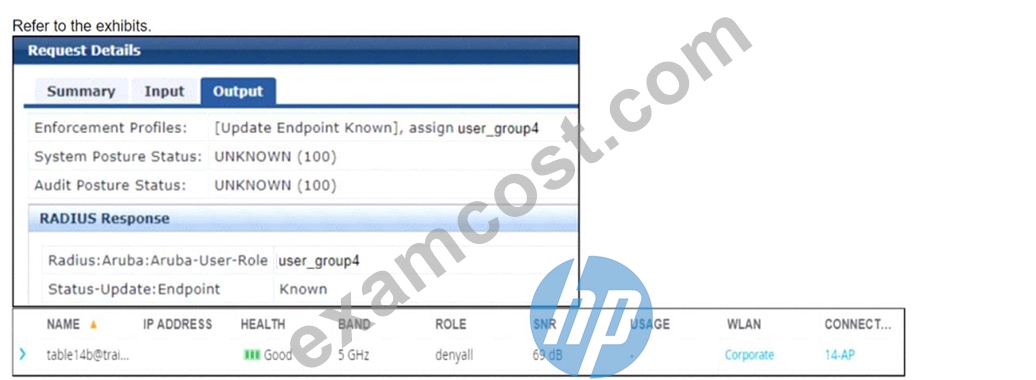
A company has added a new user group. Users in the group try to connect to the WLAN and receive errors that the connection has no Internet access. The users cannot reach any resources. The first exhibit shows the record for one of the users who cannot connect. The second exhibit shows the role to which the ArubaOS device assigned the user's client.
What is a likely problem?
- A. The role name that CPPM is sending does not match the role name configured on the Aru-baOS device.
- B. The ArubaOS device does not have the correct RADIUS dictionaries installed on it to under-stand the Aruba-User-Role VSA.
- C. The clients rejected the server authentication on their side because they do not have the root CA for CPPM's RADIUS/EAP certificate.
- D. The ArubaOS device has a server derivation rule configured on it that has overridden the role sent by CPPM.
Answer: A
Explanation:
The image indicates that there is an issue with the user role assignment, which is key to network access in ArubaOS. If the user role name sent by CPPM doesn't match any of the roles defined in the ArubaOS, then the user will be assigned a default or incorrect role that does not have the necessary permissions, thus leading to the connection errors and lack of Internet access. Ensuring that the role names are consistent between CPPM and ArubaOS can resolve this issue.
NEW QUESTION # 38
What is one way a noneypot can be used to launch a man-in-the-middle (MITM) attack to wireless clients?
- A. it uses ARP poisoning to disconnect wireless clients from the legitimate wireless network and force clients to connect to the hacker's wireless network instead.
- B. it examines wireless clients' probes and broadcasts the SSlDs in the probes, so that wireless clients will connect to it automatically.
- C. it uses a combination or software and hardware to jam the RF band and prevent the client from connecting to any wireless networks
- D. it runs an NMap scan on the wireless client to And the clients MAC and IP address. The hacker then connects to another network and spoofs those addresses.
Answer: B
Explanation:
A honeypot can be used to launch a Man-in-the-Middle (MITM) attack on wireless clients by examining wireless clients' probe requests and then broadcasting the SSIDs in those probes. Clients with those SSIDs in their preferred network list may then automatically connect to the honeypot, believing it to be a legitimate network. Once the client is connected to the attacker's honeypot, the attacker can intercept, monitor, or manipulate the client's traffic, effectively executing a MITM attack.
NEW QUESTION # 39
Why might devices use a Diffie-Hellman exchange?
- A. to signal that they want to use asymmetric encryption for future communications
- B. to agree on a shared secret in a secure manner over an insecure network
- C. to prove knowledge of a passphrase without transmitting the passphrase
- D. to obtain a digital certificate signed by a trusted Certification Authority
Answer: B
Explanation:
Devices use the Diffie-Hellman exchange to agree on a shared secret in a secure manner over an insecure network. The main purpose of this cryptographic protocol is to enable two parties to establish a shared secret over an unsecured communication channel. This shared secret can then be used to encrypt subsequent communications using a symmetric key cipher. The Diffie-Hellman exchange is particularly valuable because it allows the secure exchange of cryptographic keys over a public channel without the need for a prior shared secret. This protocol is a foundational element for many secure communications protocols, including SSL/TLS, which is used to secure connections on the internet. to the Diffie-Hellman protocol and its uses can be found in standard cryptographic textbooks and documentation such as those from the Internet Engineering Task Force (IETF) and security protocol specifications.
NEW QUESTION # 40
What is a correct guideline for the management protocols that you should use on ArubaOS-Switches?
- A. Disable SSH and use https instead.
- B. Disable Telnet and use SSH instead
- C. Disable Telnet and use TFTP instead.
- D. Disable HTTPS and use SSH instead
Answer: B
Explanation:
In managing ArubaOS-Switches, the best practice is to disable less secure protocols such as Telnet and use more secure alternatives like SSH (Secure Shell). SSH provides encrypted connections between network devices, which is critical for maintaining the security and integrity of network communications. This guideline is aligned with general security best practices that prioritize the use of protocols with strong, built-in encryption mechanisms to prevent unauthorized access and ensure data privacy.
NEW QUESTION # 41
A company with 439 employees wants to deploy an open WLAN for guests. The company wants the experience to be as follows:
* Guests select the WLAN and connect without having to enter a password.
* Guests are redirected to a welcome web page and log in.
The company also wants to provide encryption for the network for devices that are capable. Which security options should you implement for the WLAN?
- A. WPA3-Personal and MAC-Auth
- B. Captive portal and Opportunistic Wireless Encryption (OWE) in transition mode
- C. Opportunistic Wireless Encryption (OWE) and WPA3-Personal
- D. Captive portal and WPA3-Personal
Answer: B
Explanation:
Opportunistic Wireless Encryption (OWE) provides encrypted communications on open Wi-Fi networks, which addresses the company's desire to have encryption without requiring a password for guests. It can work in transition mode, which allows for the use of OWE by clients that support it, while still permitting legacy clients to connect without encryption. Combining this with a captive portal enables the desired welcome web page for guests to log in.
NEW QUESTION # 42
What is a benefit or using network aliases in ArubaOS firewall policies?
- A. You can associate a reputation score with the network alias to create rules that filler traffic based on reputation rather than IP.
- B. You can adjust the IP addresses in the aliases, and the rules using those aliases automatically update
- C. You can use the aliases to translate client IP addresses to other IP addresses on the other side of the firewall
- D. You can use the aliases to conceal the true IP addresses of servers from potentially untrusted clients.
Answer: B
Explanation:
In ArubaOS firewall policies, using network aliases allows administrators to manage groups of IP addresses more efficiently. By associating multiple IPs with a single alias, any changes made to the alias (like adding or removing IP addresses) are automatically reflected in all firewall rules that reference that alias. This significantly simplifies the management of complex rulesets and ensures consistency across security policies, reducing administrative overhead and minimizing the risk of errors.
NEW QUESTION # 43
Which is a correct description of a stage in the Lockheed Martin kill chain?
- A. In the exploitation and installation phases, malware creates a backdoor into the infected system for the hacker.
- B. In the delivery stage, malware collects valuable data and delivers or exfilltrated it to the hacker.
- C. In the weaponization stage, which occurs after malware has been delivered to a system, the malware executes Its function.
- D. In the reconnaissance stage, the hacker assesses the impact of the attack and how much information was exfilltrated.
Answer: D
NEW QUESTION # 44
You have been instructed to look in the ArubaOS Security Dashboard's client list. Your goal is to find clients that belong to the company and have connected to devices that might belong to hackers.
Which client fits this description?
- A. MAC address: d8:50:e6:f3:6e:60; Client Classification: Interfering; AP Classification: Authorized
- B. MAC address: d8:50:e6:f3:6e:c5; Client Classification: Interfering; AP Classification: Neighbor
- C. MAC address: d8:50:e6:f3:70:ab; Client Classification: Interfering; AP Classification: Rogue
- D. MAC address: d8:50:e6:f3:6d:a4; Client Classification: Authorized; AP Classification: Rogue
Answer: D
Explanation:
The ArubaOS Security Dashboard, part of the AOS-8 architecture (Mobility Controllers or Mobility Master), provides visibility into wireless clients and access points (APs) through its Wireless Intrusion Prevention (WIP) system. The goal is to identify clients that belong to the company (i.e., authorized clients) and have connected to devices that might belong to hackers (i.e., rogue APs).
Client Classification:
Authorized: A client that has successfully authenticated to an authorized AP and is recognized as part of the company's network (e.g., an employee device).
Interfering: A client that is not authenticated to the company's network and is considered external or potentially malicious.
AP Classification:
Authorized: An AP that is part of the company's network and managed by the MC/MM.
Rogue: An AP that is not authorized and is suspected of being malicious (e.g., connected to the company's wired network without permission).
Neighbor: An AP that is not part of the company's network but is not connected to the wired network (e.g., a nearby AP from another organization).
The requirement is to find a client that is authorized (belongs to the company) and connected to a rogue AP (might belong to hackers).
Option A: MAC address: d8:50:e6:f3:70:ab; Client Classification: Interfering; AP Classification: Rogue This client is classified as "Interfering," meaning it does not belong to the company. Although it is connected to a rogue AP, it does not meet the requirement of being a company client.
Option B: MAC address: d8:50:e6:f3:6e:c5; Client Classification: Interfering; AP Classification: Neighbor This client is "Interfering" (not a company client) and connected to a "Neighbor" AP, which is not considered a hacker's device (it's just a nearby AP).
Option C: MAC address: d8:50:e6:f3:6e:60; Client Classification: Interfering; AP Classification: Authorized This client is "Interfering" (not a company client) and connected to an "Authorized" AP, which is part of the company's network, not a hacker's device.
Option D: MAC address: d8:50:e6:f3:6d:a4; Client Classification: Authorized; AP Classification: Rogue This client is "Authorized," meaning it belongs to the company, and it is connected to a "Rogue" AP, which might belong to hackers. This matches the requirement perfectly.
The HPE Aruba Networking AOS-8 8.11 User Guide states:
"The Security Dashboard in ArubaOS provides a client list that includes the client classification and the AP classification for each client. A client classified as 'Authorized' has successfully authenticated to an authorized AP and is part of the company's network. A 'Rogue' AP is an unauthorized AP that is suspected of being malicious, often because it is connected to the company's wired network (e.g., detected via Eth-Wired-Mac-Table match). To identify potential security risks, look for authorized clients connected to rogue APs, as this may indicate that a company device has connected to a hacker's AP." (Page 415, Security Dashboard Section) Additionally, the HPE Aruba Networking Security Guide notes:
"An 'Authorized' client is one that has authenticated to an AP managed by the controller, typically an employee or corporate device. A 'Rogue' AP is classified as such if it is not authorized and poses a potential threat, such as being connected to the corporate LAN. Identifying authorized clients connected to rogue APs is critical for detecting potential man-in-the-middle attacks." (Page 78, WIP Classifications Section)
:
HPE Aruba Networking AOS-8 8.11 User Guide, Security Dashboard Section, Page 415.
HPE Aruba Networking Security Guide, WIP Classifications Section, Page 78.
NEW QUESTION # 45
What is one benefit of a Trusted Platform Module (TPM) on an Aruba AP?
- A. It enables the AP to encrypt and decrypt 802.11 traffic locally, rather than at the MC.
- B. It deploys the AP with enhanced security, which includes disabling the password recovery mechanism.
- C. It enables secure boot, which detects if hackers corrupt the OS with malware.
- D. It allows the AP to run in secure mode, which automatically enables CPsec and disables the console port.
Answer: C
Explanation:
The TPM (Trusted Platform Module) is a hardware-based security feature that can provide various security functions, one of which includes secure boot. Secure boot is a process where the TPM ensures that the device boots using only software that is trusted by the manufacturer. If the OS has been tampered with or infected with malware, the secure boot process can detect this and prevent the system from loading the compromised OS.
NEW QUESTION # 46
A user attempts to connect to an SSID configured on an AOS-8 mobility architecture with Mobility Controllers (MCs) and APs. The SSID enforces WPA3-Enterprise security and uses HPE Aruba Networking ClearPass Policy Manager (CPPM) as the authentication server. The WLAN has initial role, logon, and 802.1X default role, guest.
A user attempts to connect to the SSID, and CPPM sends an Access-Accept with an Aruba-User-Role VSA of "contractor," which exists on the MC.
What does the MC do?
- A. Applies the rules in the logon role, then guest role, and the contractor role
- B. Applies the rules in the contractor role and guest role
- C. Applies the rules in the contractor role and the logon role
- D. Applies the rules in the contractor role
Answer: D
Explanation:
In an AOS-8 mobility architecture, the Mobility Controller (MC) manages user roles and policies for wireless clients connecting to SSIDs. When a user connects to an SSID with WPA3-Enterprise security, the MC uses 802.1X authentication to validate the user against an authentication server, in this case, HPE Aruba Networking ClearPass Policy Manager (CPPM). The SSID is configured with specific roles:
Initial role: Applied before authentication begins (not specified in the question, but typically used for pre-authentication access).
Logon role: Applied during the authentication process to allow access to authentication services (e.g., DNS, DHCP, or RADIUS traffic).
802.1X default role (guest): Applied if 802.1X authentication fails or if no specific role is assigned by the RADIUS server after successful authentication.
In this scenario, the user successfully authenticates, and CPPM sends an Access-Accept message with an Aruba-User-Role Vendor-Specific Attribute (VSA) set to "contractor." The "contractor" role exists on the MC, meaning it is a predefined role in the MC's configuration.
When the MC receives the Aruba-User-Role VSA, it applies the specified role ("contractor") to the user session, overriding the default 802.1X role ("guest"). The MC does not combine the contractor role with other roles like logon or guest; it applies only the role specified by the RADIUS server (CPPM) in the Aruba-User-Role VSA. This is the standard behavior in AOS-8 for role assignment after successful authentication when a VSA specifies a role.
Option A, "Applies the rules in the logon role, then guest role, and the contractor role," is incorrect because the MC does not apply multiple roles in sequence. The logon role is used only during authentication, and the guest role (default 802.1X role) is overridden by the contractor role specified in the VSA.
Option C, "Applies the rules in the contractor role and the logon role," is incorrect because the logon role is no longer applied once authentication is complete; only the contractor role is applied.
Option D, "Applies the rules in the contractor role and guest role," is incorrect because the guest role (default 802.1X role) is not applied when a specific role is assigned via the Aruba-User-Role VSA.
The HPE Aruba Networking AOS-8 8.11 User Guide states:
"When a user authenticates successfully via 802.1X, the Mobility Controller applies the role specified in the Aruba-User-Role VSA returned by the RADIUS server in the Access-Accept message. If the role specified in the VSA exists on the controller, it is applied to the user session, overriding any default 802.1X role configured for the WLAN. The controller does not combine the VSA-specified role with other roles, such as the initial, logon, or default roles." (Page 305, Role Assignment Section) Additionally, the HPE Aruba Networking ClearPass Policy Manager 6.11 User Guide notes:
"ClearPass can send the Aruba-User-Role VSA in a RADIUS Access-Accept message to assign a specific role to the user on Aruba Mobility Controllers. The role specified in the VSA takes precedence over any default roles configured on the WLAN, ensuring that the user is placed in the intended role." (Page 289, RADIUS Enforcement Section)
:
HPE Aruba Networking AOS-8 8.11 User Guide, Role Assignment Section, Page 305.
HPE Aruba Networking ClearPass Policy Manager 6.11 User Guide, RADIUS Enforcement Section, Page 289.
NEW QUESTION # 47
How can ARP be used to launch attacks?
- A. A hacker can send gratuitous ARP messages with the default gateway IP to cause devices to redirect traffic to the hacker's MAC address.
- B. Hackers can exploit the fact that the port used for ARP must remain open and thereby gain remote access to another user's device.
- C. Hackers can use ARP to change their NIC's MAC address so they can impersonate legiti-mate users.
- D. A hacker can use ARP to claim ownership of a CA-signed certificate that actually belongs to another device.
Answer: A
Explanation:
ARP (Address Resolution Protocol) can indeed be exploited to conduct various types of attacks, most notably ARP spoofing/poisoning. Gratuitous ARP is a special kind of ARP message which is used by an IP node to announce or update its IP to MAC mapping to the entire network. A hacker can abuse this by sending out gratuitous ARP messages pretending to associate the IP address of the router (default gateway) with their own MAC address. This results in traffic that was supposed to go to the router being sent to the attacker instead, thus potentially enabling the attacker to intercept, modify, or block traffic.
NEW QUESTION # 48
What is a Key feature of me ArubaOS firewall?
- A. The firewall Includes application layer gateways (ALGs). which it uses to filter Web traffic based on the reputation of the destination web site.
- B. The firewall is stateful which means that n can track client sessions and automatically allow return traffic for permitted sessions
- C. The firewall examines all traffic at Layer 2 through Layer 4 and uses source IP addresses as the primary way to determine how to control traffic.
- D. The firewall is designed to fitter traffic primarily based on wireless 802.11 headers, making it ideal for mobility environments
Answer: A
NEW QUESTION # 49
What is one practice that can help you to maintain a digital chain or custody In your network?
- A. Enable packet capturing on Instant AP or Moodily Controller (MC) datepath on an ongoing basis
- B. Ensure that all network infrastructure devices receive a valid clock using authenticated NTP
- C. Enable packet capturing on Instant AP or Mobility Controller (MC) control path on an ongoing basis.
- D. Ensure that all network Infrastructure devices use RADIUS rather than TACACS+ to authenticate managers
Answer: B
Explanation:
To maintain a digital chain of custody in a network, a crucial practice is to ensure that all network infrastructure devices receive a valid clock using authenticated Network Time Protocol (NTP). Accurate and synchronized time stamps are essential for creating reliable and legally defensible logs. Authenticated NTP ensures that the time being set on devices is accurate and that the time source is verified, which is necessary for correlating logs from different devices and for forensic analysis.
:
Digital forensics and network security protocols that underscore the importance of accurate timekeeping for maintaining a digital chain of custody.
NTP configuration guidelines for network devices, emphasizing the use of authentication to prevent tampering with clock settings.
NEW QUESTION # 50
What are the roles of 802.1X authenticators and authentication servers?
- A. The authenticator makes access decisions and the server communicates them to the supplicant.
- B. The authenticator supports only EAP, while the authentication server supports only RADIUS.
- C. The authenticator stores the user account database, while the server stores access policies.
- D. The authenticator is a RADIUS client and the authentication server is a RADIUS server.
Answer: D
Explanation:
In the 802.1X network access control model, the roles of the authenticator and the authentication server are distinct yet complementary. The authenticator acts as a RADIUS client, which is a network device, like a switch or wireless access point, that directly interfaces with the client machine (supplicant). The authentication server, typically a RADIUS server, is responsible for verifying the credentials provided by the supplicant through the authenticator. This setup helps in separating the duties where the authenticator enforces authentication but does not decide on the validity of the credentials, which is the role of the authentication server.References:
IEEE 802.1X standard for network access control.
NEW QUESTION # 51 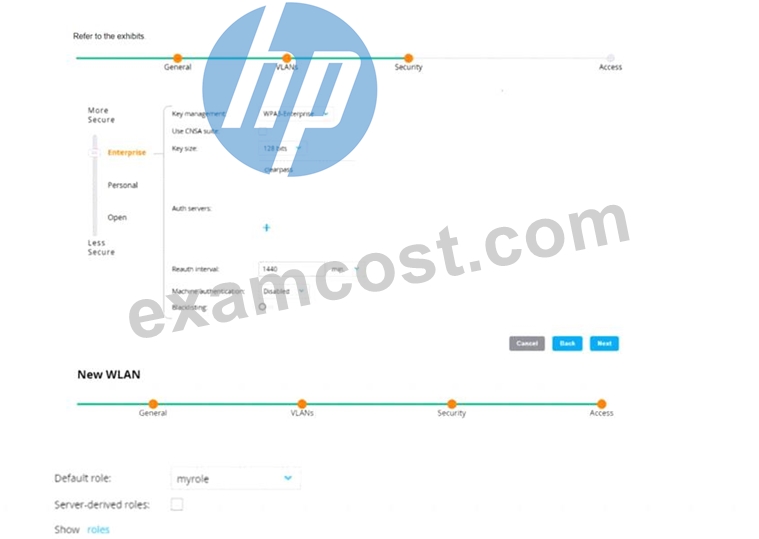
An admin has created a WLAN that uses the settings shown in the exhibits (and has not otherwise adjusted the settings in the AAA profile) A client connects to the WLAN Under which circumstances will a client receive the default role assignment?
- A. The client has attempted 802 1X authentication, but the MC could not contact the authentication server
- B. The client has passed 802 1X authentication, and the value in the Aruba-User-Role VSA matches a role on the MC
- C. The client has attempted 802 1X authentication, but failed to maintain a reliable connection, leading to a timeout error
- D. The client has passed 802 1X authentication and the authentication server did not send an Aruba-User-Role VSA
Answer: D
Explanation:
In the context of an Aruba Mobility Controller (MC) configuration, a client will receive the default role assignment if they have passed 802.1X authentication and the authentication server did not send an Aruba-User-Role Vendor Specific Attribute (VSA). The default role is assigned by the MC when a client successfully authenticates but the authentication server provides no specific role instruction. This behavior ensures that a client is not left without any role assignment, which could potentially lead to a lack of network access or access control. This default role assignment mechanism is part of Aruba's role-based access control, as documented in the ArubaOS user guide and best practices.
NEW QUESTION # 52
Your ArubaoS solution has detected a rogue AP with Wireless intrusion Prevention (WIP). Which information about the detected radio can best help you to locate the rogue device?
- A. the match method
- B. the confidence level
- C. the detecting devices
- D. the match type
Answer: A
NEW QUESTION # 53
A client is connected to a Mobility Controller (MC). These firewall rules apply to this client's role:
ipv4 any any svc-dhcp permit
ipv4 user 10.5.5.20 svc-dns permit
ipv4 user 10.1.5.0 255.255.255.0 https permit
ipv4 user 10.1.0.0 255.255.0.0 https deny_opt
ipv4 user any any permit
What correctly describes how the controller treats HTTPS packets to these two IP addresses, both of which are on the other side of the firewall:
10.1.20.1
10.5.5.20
- A. Both packets are permitted.
- B. The first packet is permitted, and the second is denied.
- C. The first packet is denied, and the second is permitted.
- D. Both packets are denied.
Answer: C
Explanation:
In an HPE Aruba Networking AOS-8 Mobility Controller (MC), firewall rules are applied based on the user role assigned to a client. The rules are evaluated in order, and the first matching rule determines the action (permit or deny) for the packet. The client's role has the following firewall rules:
ipv4 any any svc-dhcp permit: Permits DHCP traffic (UDP ports 67 and 68) from any source to any destination.
ipv4 user 10.5.5.20 svc-dns permit: Permits DNS traffic (UDP port 53) from the user to the IP address 10.5.5.20.
ipv4 user 10.1.5.0 255.255.255.0 https permit: Permits HTTPS traffic (TCP port 443) from the user to the subnet 10.1.5.0/24.
ipv4 user 10.1.0.0 255.255.0.0 https deny_opt: Denies HTTPS traffic from the user to the subnet 10.1.0.0/16, with the deny_opt action (which typically means deny with an optimized action, such as dropping the packet without logging).
ipv4 user any any permit: Permits all other traffic from the user to any destination.
The question asks how the MC treats HTTPS packets (TCP port 443) to two IP addresses: 10.1.20.1 and 10.5.5.20.
HTTPS packet to 10.1.20.1:
Rule 1: Does not match (traffic is HTTPS, not DHCP).
Rule 2: Does not match (destination is 10.1.20.1, not 10.5.5.20; traffic is HTTPS, not DNS).
Rule 3: Does not match (destination 10.1.20.1 is not in the subnet 10.1.5.0/24).
Rule 4: Matches (destination 10.1.20.1 is in the subnet 10.1.0.0/16, and traffic is HTTPS). The action is deny_opt, so the packet is denied.
HTTPS packet to 10.5.5.20:
Rule 1: Does not match (traffic is HTTPS, not DHCP).
Rule 2: Does not match (traffic is HTTPS, not DNS).
Rule 3: Does not match (destination 10.5.5.20 is not in the subnet 10.1.5.0/24).
Rule 4: Does not match (destination 10.5.5.20 is not in the subnet 10.1.0.0/16).
Rule 5: Matches (catches all other traffic). The action is permit, so the packet is permitted.
Therefore, the HTTPS packet to 10.1.20.1 is denied, and the HTTPS packet to 10.5.5.20 is permitted.
Option A, "Both packets are denied," is incorrect because the packet to 10.5.5.20 is permitted.
Option B, "The first packet is permitted, and the second is denied," is incorrect because the packet to 10.1.20.1 (first) is denied, and the packet to 10.5.5.20 (second) is permitted.
Option C, "Both packets are permitted," is incorrect because the packet to 10.1.20.1 is denied.
Option D, "The first packet is denied, and the second is permitted," is correct based on the rule evaluation.
The HPE Aruba Networking AOS-8 8.11 User Guide states:
"Firewall policies on the Mobility Controller are evaluated in order, and the first matching rule determines the action for the packet. For example, a rule such as ipv4 user 10.1.0.0 255.255.0.0 https deny_opt will deny HTTPS traffic to the specified subnet, while a subsequent rule like ipv4 user any any permit will permit all other traffic that does not match earlier rules. The 'user' keyword in the rule refers to the client's IP address, and the rules are applied to traffic initiated by the client." (Page 325, Firewall Policies Section) Additionally, the guide notes:
"The deny_opt action in a firewall rule drops the packet without logging, optimizing performance for high-volume traffic. Rules are processed sequentially, and only the first matching rule is applied." (Page 326, Firewall Actions Section)
:
HPE Aruba Networking AOS-8 8.11 User Guide, Firewall Policies Section, Page 325.
HPE Aruba Networking AOS-8 8.11 User Guide, Firewall Actions Section, Page 326.
NEW QUESTION # 54
......
HP HPE6-A78 exam is an essential step for IT professionals who want to advance their careers in network security. Obtaining the ACNSA certification demonstrates a high level of expertise in network security and can lead to exciting job opportunities in this field.
HP HPE6-A78 exam is an excellent certification for networking professionals who are interested in advancing their careers in network security. Aruba Certified Network Security Associate Exam certification validates the candidate's knowledge and skills in implementing Aruba's security solutions effectively. HPE6-A78 exam covers a wide range of topics related to network security, and passing it demonstrates the candidate's expertise in designing, implementing, and managing secure networks.
HPE6-A78 certification is recognized globally and is highly valued by employers in the IT industry. It demonstrates a candidate's proficiency in implementing and managing secure network infrastructures using Aruba products and technologies. Aruba Certified Network Security Associate Exam certification is also a stepping stone for higher-level Aruba certifications such as the Aruba Certified Mobility Professional (ACMP) and the Aruba Certified Mobility Expert (ACMX).
HPE6-A78 Exam Dumps Pass with Updated 2025 Certified Exam Questions: https://www.examcost.com/HPE6-A78-practice-exam.html
Guide (New 2025) Actual HP HPE6-A78 Exam Questions: https://drive.google.com/open?id=1LxaYjlqBCaKgf7kdmwZhp2i85W0SniTr
