

Get 2026 Updated Free Nutanix NCP-CN Exam Questions and Answer
NCP-CN Dumps PDF and Test Engine Exam Questions
Nutanix NCP-CN Exam Syllabus Topics:
| Topic | Details |
|---|---|
| Topic 1 |
|
| Topic 2 |
|
| Topic 3 |
|
| Topic 4 |
|
NEW QUESTION # 14
A Platform Engineer is attempting to delete an attached cluster from the NKP UI, but it is stuck in a 'deleting' state and does not get removed. How can the engineer resolve this attempt to detach the cluster so that it is removed from the UI and no longer managed by NKP?
- A. Run the kubectl delete kommandercluster command in the context of the NKP management cluster.
- B. Run the nkp delete cluster command in the context of the NKP attached cluster.
- C. Run the nkp delete kommandercluster command in the context of the NKP attached cluster.
- D. Run the kubectl delete cluster command in the context of the NKP management cluster.
Answer: A
NEW QUESTION # 15
A Platform Engineer manages an NKP environment and is preparing a machine image to become an NKP cluster node. Which statement is correct regarding the default node preparation process?
- A. Terraform is utilized to clone an existing OS image for use as an NKP node.
- B. Ansible is used to make the OS image CAPI-compliant for use as an NKP node.
- C. Packer is used to make the OS image CAPI-compliant for use as an NKP node.
- D. Goss is used to harden the OS image for use as an NKP node.
Answer: C
NEW QUESTION # 16
A development team is working on a new application that requires access to certain cluster resources. The team needs to ensure that they have limited permissions to avoid unauthorized changes in other environments.
Among the tasks they will perform are the following:
* Deploy new versions of the application to their specific namespace.
* Scale deployments according to demand.
* View logs and metrics of their applications to monitor performance.When using the NKP GUI, what type of access should the team configure?
- A. Kommander Role
- B. Cluster Admin
- C. NKP Role
- D. Cluster Role
Answer: C
Explanation:
The NKPA course explains that NKP provides a role-based access control (RBAC) system to manage permissions within its platform, in addition to Kubernetes-native RBAC. For a development team needing limited permissions to perform specific tasks (deploying applications, scaling deployments, viewing logs and metrics) within a specific namespace, the appropriate access type in the NKP GUI is an NKP Role.
NKP Roles are predefined or custom roles within the NKP platform that map to Kubernetes RBAC permissions but are managed through the NKP UI for ease of use. They allow granular control over actions within a workspace or namespace, ensuring the team can perform their tasks (e.g., deploy, scale, get logs) without having access to other environments or cluster-wide resources. For example, an NKP Role like
"Developer" or a custom role can be configured to grant edit permissions in the team's namespace while restricting access elsewhere. The Nutanix Cloud Native (NCP-CN) 6.10 Study Guide states: "In the NKP GUI, configure an NKP Role to grant limited permissions to a development team, allowing actions like deploying applications and viewing logs within their namespace while preventing unauthorized changes in other environments." Incorrect Options:
* B. Cluster Role: A Kubernetes Cluster Role grants permissions across all namespaces, which is too broad for the team's limited access requirement.
* C. Cluster Admin: This grants full administrative access to the entire cluster, far exceeding the team's needs and violating the principle of least privilege.
* D. Kommander Role: Kommander is a management component in NKP, but "Kommander Role" is not a specific access type in the NKP GUI for this purpose.
:
Nutanix Kubernetes Platform Administration (NKPA) Course, Section on Access Control and RBAC.
Nutanix Cloud Native (NCP-CN) 6.10 Study Guide, Chapter on Day 2 Operations.
Nutanix Cloud Bible, NutanixKubernetesPlatform Section: https://www.nutanixbible.com
NEW QUESTION # 17 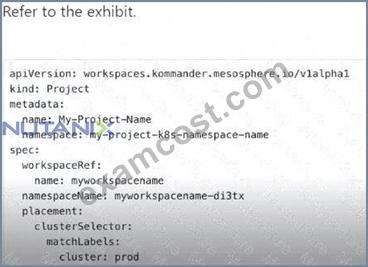
After creating the project, what should the administrator configure in order for the new software releases to automatically deploy to both environments?
- A. Project ConfigMaps
- B. Project Secrets
- C. Continue Integration (CI)
- D. Continue Deployment (CD)
Answer: D
Explanation:
Continuous Deployment (CD) is the practice of automatically deploying new software releases across environments after a successful build and testing phase. In the context of NKP, enabling CD ensures that software changes are consistently and reliably rolled out to all clusters associated with a project, ensuring operational uniformity and rapid feature adoption.
References: Nutanix Kubernetes Platform Administration Guide - CI/CD Integration for NKP
NEW QUESTION # 18
A Platform Engineer manages an NKP environment and is preparing a machine image to become an NKP cluster node. Which statement is correct regarding the default node preparation process?
- A. Terraform is utilized to clone an existing OS image for use as an NKP node.
- B. Ansible is used to make the OS image CAPI-compliant for use as an NKP node.
- C. Packer is used to make the OS image CAPI-compliant for use as an NKP node.
- D. Goss is used to harden the OS image for use as an NKP node.
Answer: C
Explanation:
The NKPA course details the default node preparation process for NKP cluster nodes, which involves creating a machine image that is compliant with Cluster API (CAPI) standards. The primary tool used in this process is Packer, which automates the creation of machine images by provisioning a base OS image (e.g., Ubuntu or Rocky Linux) with the necessary components for Kubernetes, such as kubeadm, containerd, and other dependencies.
Packer ensures the image is CAPI-compliant by installing the required Kubernetes binaries, configuring the container runtime, and setting up networking and storage components. The Nutanix Cloud Native (NCP-CN)
6.10 Study Guide states: "In the default node preparation process for NKP, Packer is used to build a CAPI- compliant OS image, installing Kubernetes components and dependencies for use as an NKP node." This process is typically orchestrated by NKP Image Builder (NIB) or Kubernetes Image Builder (KIB), both of which rely on Packer for image creation.
Incorrect Options:
* B. Ansible is used to make the OS image CAPI-compliant: Ansible is used by KIB/NIB to apply configurations during the Packer build process, but Packer is the primary tool for creating the image.
Ansible alone does not make the image CAPI-compliant.
* C. Goss is used to harden the OS image: Goss is a validation tool that can be used for image hardening, but it is not part of the default NKP node preparation process. Hardening is an optional step.
* D. Terraform is utilized to clone an existing OS image: Terraform is for infrastructure provisioning, not image creation or cloning. Packer handles image creation in NKP.
:
Nutanix Kubernetes Platform Administration (NKPA) Course, Section on Node Preparation.
Nutanix Cloud Native (NCP-CN) 6.10 Study Guide, Chapter on NKP Deployment Prerequisites.
Nutanix Cloud Bible, NutanixKubernetesPlatform Section: https://www.nutanixbible.com Packer Documentation: https://www.packer.io
NEW QUESTION # 19
A Platform Engineer for an organization needs to deploy NKP into AWS while using custom credentials for authenticating. Which flag should the engineer use when starting to bootstrap the cluster installation?
- A. --with-aws-bootstrap-credentials=true<br>
- B. --cloud-credentials=<my-profile><br>
- C. --aws-access-key=<aws access="" key=""> --aws-secret-key=<aws secret="" key=""></aws></aws></my-profile></my-profile>
- D. --aws-profile=<my-profile><br>
Answer: D
NEW QUESTION # 20
In an effort to control cloud cost consumption, auto-scale is configured to meet demands as needed.
What is the behavior for when nodes are scaled down?
- A. Node is changed to a status of Hibernate.
- B. Node is CAPI deleted from its infrastructure provider, effectively removing it from its hypervisor.
- C. Node is paused in Kubernetes and the infrastructure continues to consume the resources at the current level.
- D. Node is changed to a status of Power-Off for stand-by.
Answer: B
Explanation:
As per the NKPA 6.10 documentation and cluster autoscaler behavior, when nodes are scaled down in NKP (or any CAPI-managed environment), the node is deleted from the infrastructure provider (vSphere, AWS, Nutanix, etc.). This effectively removes it from both the cluster and the underlying hypervisor or cloud provider, thus freeing up resources and reducing costs.
Reference:
Nutanix Kubernetes Platform Administration (NKPA) 6.10 - "Cluster Autoscaler Node Deletion Behavior" NCP-CN 6.10 Study Guide - "Autoscaler Impact on Infrastructure Resources"
NEW QUESTION # 21
During a deployment of NKP, a Platform Engineer received an error indicating an issue with the bootstrap. While troubleshooting with support, the engineer noticed that the KUBECONFIG file was missing. How would the engineer recreate the bootstrap cluster and create a context file named bootstrap-cluster.conf?
- A. nutanix create bootstrap --kubeconfig bootstrap-cluster.conf
- B. d2iq create bootstrap --kubeconfig bootstrap-cluster.conf
- C. nkp create bootstrap --kubeconfig bootstrap-cluster.conf
- D. kubectl create bootstrap --kubeconfig bootstrap-cluster.conf
Answer: C
NEW QUESTION # 22 
The cluster arca will host a new application that needs to add more workers. The company cannot get more NKP licenses, so it has decided to delete the demo cluster and add the required workers to the arca cluster. How should the engineer delete the demo cluster from this UI?
- A. Press the ("demo" cluster line) three-dot menu at the right and select Delete.
- B. Login with SSH to the kommander cluster and execute kubectl delete cluster -c demo
- C. Press the ("demo" cluster line) three-dot menu at the right and select Download kubeconfig, then use that file to execute kubectl delete cluster -c demo --kubeconfig=demo.conf
- D. Press the ("demo" cluster line) three-dot menu at the right and select Detach. Then ask the cluster owner to delete the cluster.
Answer: A
NEW QUESTION # 23 
A Platform Engineer is preparing to deploy an NKP cluster in an air-gapped environment. The NKP cluster will be deployed on Nutanix infrastructure using the CAPI Nutanix provisioner (CAPX). The engineer has decided to create the bootstrap cluster first, then NIB-prep an Ubuntu 22.04 OS image that the Linux engineering team has provided in Prism Central. After that, the engineer will deploy the NKP cluster. However, during the first step of creating a bootstrap cluster, the engineer received the error shown in the exhibit. What could be the reason?
- A. The Ubuntu 22.04 OS image needs to be NIB-prepped prior to creating the bootstrap.
- B. The CAPI provisioning method needs to be specified as part of the command nkp create bootstrap nutanix.
- C. The bootstrap cluster image needs to be loaded prior to creating the bootstrap cluster.
- D. The nkp create bootstrap command needs to be executed as root.
Answer: C
NEW QUESTION # 24
A company recently deployed NKP. A Platform Engineer was asked to attach the existing Amazon EKS. A workspace and project were created accordingly, and resource requirements were met. What does the engineer need to do first to prepare the EKS clusters?
- A. Configure HAProxy to get connected to EKS clusters.
- B. Deploy cert-manager in the EKS clusters.
- C. Configure a ConfigMap according to EKS configuration.
- D. Create a service account with cluster-admin permissions.
Answer: D
Explanation:
Attaching an existing Amazon EKS cluster to NKP for fleet management involves integrating the cluster into NKP's management plane, which requires specific preparatory steps. The NKPA course outlines that the first step is to create a service account with cluster-admin permissions in the EKS cluster. This service account is used by NKP to authenticate and manage the cluster, enabling operations like monitoring, scaling, and application deployment.
The Nutanix Cloud Native (NCP-CN) 6.10 Study Guide explains: "To attach an external Kubernetes cluster, such as Amazon EKS, to NKP, a service account with cluster-admin role bindings must be created to allow NKP to interact with the cluster's API server." The service account is configured with a token that NKP uses to authenticate requests. The NKPA course provides detailed steps, including creating the service account, assigning the cluster-admin ClusterRole, and generating a token for NKP integration. This step is critical to ensure NKP has the necessary permissions to manage the EKS cluster.
Incorrect Options:
* A. Configure a ConfigMap according to EKS configuration: While ConfigMaps may be used for specific configurations, they are not the first step for attaching an EKS cluster. The NKPA course prioritizes service account creation.
* C. Configure HAProxy to get connected to EKS clusters: HAProxy is a load balancer, not required for attaching EKS clusters to NKP. EKS uses AWS-native load balancers, and NKP connects via the Kubernetes API.
* D. Deploy cert-manager in the EKS clusters: Cert-manager is used for certificate management, not a prerequisite for attaching EKS clusters. The NKPA course does not list it as a required step.
:
Nutanix Kubernetes Platform Administration (NKPA) Course, Section on Fleet Management.
Nutanix Cloud Native (NCP-CN) 6.10 Study Guide, Chapter on Attaching External Clusters.
Nutanix Cloud Bible, NutanixKubernetesPlatform Section: https://www.nutanixbible.com Amazon EKS Documentation: https://docs.aws.amazon.com/eks
NEW QUESTION # 25
A Platform Engineer is attaching existing Kubernetes clusters to NKP, but some of them have network restrictions, so there is a need to use Secure Tunnel. The Platform Engineer needs to ask the Security Engineer to modify the firewall rules.
What must the firewall rules allow on the attached cluster network?
- A. NTP Service (UDP/123)
- B. Secured LDAP (TCP/636)
- C. HTTPS (TCP/443)
- D. iSCSI (TCP/860 & 3260)
Answer: C
Explanation:
The Secure Tunnel feature in NKP relies on HTTPS (TCP port 443) to establish secure, encrypted connections between the attached cluster and the management cluster, enabling fleet management even in restricted network environments.
Exact extract:
"Secure Tunnel uses TCP/443 (HTTPS) for establishing a secure connection between the attached cluster and NKP." Reference:
Nutanix Kubernetes Platform Administration (NKPA) 6.10 - "Secure Tunnel for Restricted Clusters" NCP-CN 6.10 Study Guide - "Firewall Rules for Secure Tunnel Connectivity"
=======
NEW QUESTION # 26
A Platform Engineer is deploying a new Kubernetes application in Amazon Web Services (AWS) Elastic Container Service for Kubernetes (EKS) and Azure Kubernetes Service (AKS). The engineer's team has decided to use a custom image instead of the default images provided by AWS or Azure for their clusters.
What functionality will the engineer lose in both AWS EKS and Azure AKS by choosing to use a custom image?
- A. Cluster networking and load balancing
- B. Built-in autoscaling and security capabilities
- C. Ability to use GPUs and persistent storage
- D. Native monitoring tools, logging, and alerting
Answer: B
Explanation:
Comprehensive and Detailed Explanation From General Kubernetes Knowledge:
Since this question involves AWS EKS and Azure AKS specifics outside the NKP context, and web search is unavailable, I will rely on general Kubernetes knowledge as of my last update. Using a custom image for EKS and AKS worker nodes means replacing the default, optimized images provided by AWS and Azure, which are pre-configured with components tailored for their managed Kubernetes services.
The primary functionality lost by using a custom image in both EKS and AKS is built-in autoscaling and security capabilities (Option C):
* Autoscaling: Both EKS and AKS rely on their default node images to integrate with their native autoscaling mechanisms, such as the EKS Cluster Autoscaler (which uses AWS Auto Scaling Groups) and AKS Cluster Autoscaler (which integrates with Azure Virtual Machine Scale Sets). Custom images may lack the necessary agents or configurations (e.g., AWS SSM Agent, Azure VM extensions) to communicate with these autoscaling services, requiring manual configuration.
* Security Capabilities: Default images include pre-configured security features, such as AWS's integration with IAM roles for service accounts (IRSA) and Azure's integration with Azure Active Directory (AAD) for RBAC. Custom images may not include these integrations, potentially breaking security features like automatic credential rotation or managed identity support unless manually configured.
Incorrect Options:
* A. Native monitoring tools, logging, and alerting: Monitoring and logging (e.g., AWS CloudWatch, Azure Monitor) are managed at the control plane level, not the node image level, so these features are generally unaffected by custom images.
* B. Cluster networking and load balancing: Networking (e.g., AWS VPC CNI, Azure CNI) and load balancing (e.g., AWS ALB, Azure Load Balancer) are configured by the control plane and CNI plugins, not the node image.
* D. Ability to use GPUs and persistent storage: GPU support and persistent storage (e.g., EBS, Azure Disk) depend on drivers and CSI plugins, which can be installed on custom images without losing functionality.
:
General Kubernetes Knowledge on EKS and AKS Image Customization.
AWS EKS Documentation (Conceptual): https://docs.aws.amazon.com/eks
Azure AKS Documentation (Conceptual): https://docs.microsoft.com/en-us/azure/aks
NEW QUESTION # 27
A Platform Engineer needs to do an air-gapped installation of NKP. This environment needs to run without Internet access and be fully operational, including updates. Docker has been installed, and the NKP bundle exists on a bastion host. What is the first command that the engineer must run to begin the process?
- A. tar -xzvf nkp-air-gapped-bundle_v2.12.0_linux_amd64.tar.gz
- B. nkp create cluster nutanix
- C. nkp push bundle --bundle
- D. docker load -i konvoy-bootstrap-image-v2.12.0.tar
Answer: A
NEW QUESTION # 28
When deploying NKP using the Nutanix provisioning method (CAPX), what are the supported OS platforms?
- A. CentOS and Rocky Linux
- B. CentOS and Ubuntu
- C. Flatcar, Rocky Linux, and Ubuntu
- D. Rocky Linux and Ubuntu
Answer: D
Explanation:
The NKPA course specifies the supported operating systems for NKP clusters deployed using the Nutanix provisioning method (CAPX), which leverages Cluster API for Nutanix (CAPX) to provision clusters on Nutanix AHV. The supported OS platforms for CAPX are Rocky Linux and Ubuntu, as these distributions are tested and optimized for Nutanix infrastructure and Kubernetes requirements.
Rocky Linux is a CentOS replacement adopted by Nutanix after CentOS 8's end-of-life in 2021, providing a stable, enterprise-grade OS. Ubuntu, particularly LTS versions like 20.04 or 22.04, is widely supported due to its compatibility with Kubernetes and Nutanix AHV. The Nutanix Cloud Native (NCP-CN) 6.10 Study Guide states: "When deploying NKP with the Nutanix provisioning method (CAPX), the supported OS platforms are Rocky Linux and Ubuntu, ensuring compatibility with Nutanix AHV and Kubernetes." These OS images are typically prepared using NKP Image Builder (NIB) to include necessary components like kubeadm and containerd.
Incorrect Options:
* A. CentOS and Rocky Linux: CentOS 8 is no longer supported post-2021, and Nutanix has shifted to Rocky Linux.
* C. Flatcar, Rocky Linux, and Ubuntu: Flatcar Container Linux is not a supported OS for CAPX in NKP deployments.
* D. CentOS and Ubuntu: CentOS is not supported, as noted above.
:
Nutanix Kubernetes Platform Administration (NKPA) Course, Section on Nutanix Provisioning with CAPX.
Nutanix Cloud Native (NCP-CN) 6.10 Study Guide, Chapter on NKP Deployment Prerequisites.
Nutanix Cloud Bible, NutanixKubernetesPlatform Section: https://www.nutanixbible.com
NEW QUESTION # 29
In a financial company, a DevOps team is responsible for supporting all of the company's critical applications. Although the team was experienced, the manual management for cluster health checking was becoming increasingly complicated and prone to errors.
The team consulted its company's Platform Engineer on how to best address these issues. They told the engineer that events such as these were occurring
1.Omitting pod security standards.
2.Crashlooping cases.
3.Failed nodes when deploying or running kube-bench.
What recommendation should the engineer provide to the DevOps team?
- A. Use AlertManager and NKP Insights together.
- B. Run the nkp describe cluster --cluster-name=${CLUSTER_NAME} command.
- C. Create a MachineHealthCheck resource in YAML format.
- D. Use override ConfigMaps to configure alert rules.
Answer: A
NEW QUESTION # 30
Which CAPI provisioning method requires creating an inventory file of the servers to become NKP nodes?
- A. Pre-provisioned (CAPPP)
- B. vSphere (CAPV)
- C. AWS (CAPA)
- D. Nutanix (CAPX)
Answer: A
NEW QUESTION # 31
A Platform Engineer has been tasked with setting up a secure and isolated environment for managing an NKP environment. The environment will have no access to the Internet but will be required to create additional NKP clusters in the future. The security team has recommended using a bastion host to achieve this goal. What is the primary purpose of a bastion host in this scenario?
- A. To store and manage sensitive data related to the cluster.
- B. To provide a secure point for creating and operating NKP clusters.
- C. To act as a firewall for the cluster, blocking all incoming traffic.
- D. To serve as a load balancer for the NKP clusters.
Answer: B
NEW QUESTION # 32
A Platform Engineer is running a Kubernetes cluster version 1.28.1 on AWS that needs to be upgraded to version 1.29.9. This cluster was deployed with Nutanix NKP. Which two actions should the engineer take to complete this requirement? (Choose two.)
- A. Upgrade Control Planes with nkp update controlplane aws --cluster-name=${CLUSTER_NAME} -- ami AMI_ID --kubernetes-version=v1.29.9
- B. Upgrade the Cluster with nkp update cluster aws --cluster-name=${CLUSTER_NAME} --ami AMI_ID
--kubernetes-version=v1.29.9 - C. Upgrade Workers with nkp update nodepool aws ${NODEPOOL_NAME} --cluster- name=${CLUSTER_NAME} --kubernetes-version=v1.29.9
- D. Upgrade Workers with nkp upgrade nodepool aws ${NODEPOOL_NAME} --cluster- name=${CLUSTER_NAME} --kubernetes-version=v1.29.9
Answer: A,D
Explanation:
The NKPA course details the process for upgrading an NKP-managed Kubernetes cluster, such as one running on AWS from version 1.28.1 to 1.29.9. Upgrading a Kubernetes cluster involves two distinct steps:
upgrading the control plane nodes and upgrading the worker nodes, ensuring minimal disruption and maintaining compatibility. The NKP CLI provides specific commands to handle these upgrades separately for AWS clusters.
* Upgrade Control Planes with nkp update controlplane aws --cluster-name=${CLUSTER_NAME}
--ami AMI_ID --kubernetes-version=v1.29.9 (Option B):The control plane must be upgraded first to the target Kubernetes version (1.29.9). The nkp update controlplane aws command updates the control plane nodes, specifying the cluster name, the new Kubernetes version, and an updated AMI (Amazon Machine Image) that supports the target version. The Nutanix Cloud Native (NCP-CN) 6.10 Study Guide states: "To upgrade an NKP cluster on AWS, first update the control plane using nkp update controlplane aws --cluster-name <name> --ami <ami-id> --kubernetes-version <version> to ensure the control plane runs the desired Kubernetes version." The --ami flag is required to specify a compatible image for the upgraded control plane nodes.
* Upgrade Workers with nkp upgrade nodepool aws ${NODEPOOL_NAME} --cluster- name=${CLUSTER_NAME} --kubernetes-version=v1.29.9 (Option C):After the control plane is upgraded, the worker nodes in each node pool must be upgraded to match the control plane version.
The nkp upgrade nodepool aws command updates the specified node pool to the target Kubernetes version (1.29.9). The NKPA course notes: "Upgrade worker nodes using nkp upgrade nodepool aws
<nodepool-name> --cluster-name <cluster-name> --kubernetes-version <version>, which performs a rolling update to ensure minimal downtime." This command automatically handles the rolling update of worker nodes, replacing them with new nodes running the updated version. Note that the --ami flag is not required here, as NKP typically uses the same AMI as the control plane or retrieves a compatible one based on the version.
Incorrect Options:
* A. nkp update nodepool aws: The correct command is nkp upgrade nodepool, not nkp update nodepool. The NKPA course uses upgrade for version changes to node pools.
* D. nkp update cluster aws: This command is not the standard approach for upgrading Kubernetes versions in NKP. The course specifies separate commands for control plane and node pool upgrades to ensure a controlled process.
:
Nutanix Kubernetes Platform Administration (NKPA) Course, Section on Cluster Upgrades.
Nutanix Cloud Native (NCP-CN) 6.10 Study Guide, Chapter on Day 2 Operations.
Nutanix Cloud Bible, NutanixKubernetesPlatform Section: https://www.nutanixbible.com
NEW QUESTION # 33
......
Verified NCP-CN exam dumps Q&As with Correct 111 Questions and Answers: https://www.examcost.com/NCP-CN-practice-exam.html
Get New NCP-CN Certification – Valid Exam Dumps Questions: https://drive.google.com/open?id=1OLoZksR_JuIniNhbFnu9aslexFrAY8rC
